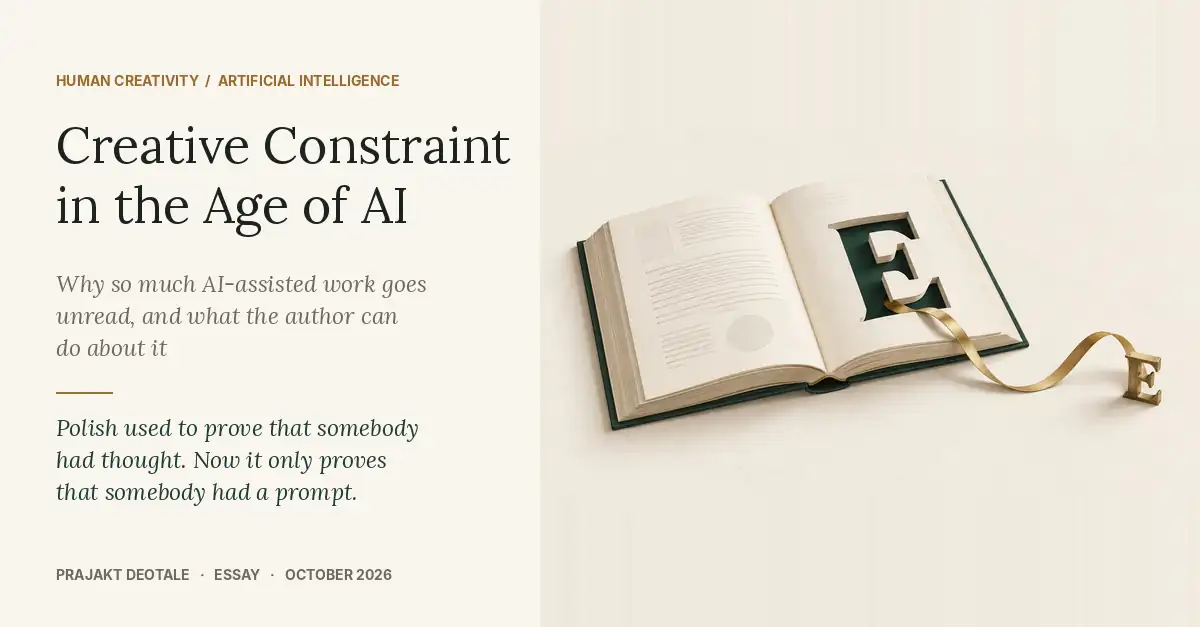
AI has made it easy to produce documents that look finished, and just as easy to produce documents that look alike. Readers have started to notice. This essay argues that the only part of any piece of work worth reading is the part the author added, and shows two ways to add it: choose a constraint the tool would not choose, and question one it would not question.
Everything looks finished
Every dashboard, deck and document I open now arrives in the same condition. The HTML page has a hero number and a tidy grid of tiles. The slide deck has a summary slide, an agenda and a recommendation in a box. The Word document runs to twenty pages, each point explained twice. The email ends with a numbered list of next steps. All of it is polished to the same degree, and the polish is the problem, because it no longer tells me anything about whether anyone has thought.
For most of my career a finished-looking document was evidence of effort. Someone had sat with the numbers, argued over the structure and decided what to leave out. The polish was a signal, and senior people learnt to read it. That signal has broken. Fluency is now the default output of a prompt, where length is free and so is over-explanation, and the surface that used to say somebody has been here now says only that a model has.
The number that could not be true
Earlier this month I was asked, outside my day job, to look over a value dashboard that a small company had built to support a funding conversation. It was an HTML page and it was beautiful: three years of benefit, a tile for each year and a cumulative total above them, every figure to the pound. The size of that benefit was the whole point of the meeting. And the benefit was wrong. The total the programme would deliver across three years had been placed in each year’s tile as though it would arrive annually, so the page claimed roughly three times what the underlying model supported. Nothing on the surface gave it away. You had to open the calculations, and when I did, nobody on the sending side had been there before me.
The founders corrected it the same afternoon. The tool, asked what had gone wrong, apologised. The dashboard was not wrong because a model made an arithmetic error; models make arithmetic errors. It was wrong because the page had been produced without anyone being required to read it, and a page that nobody was required to read now looks identical to one that somebody has. I see that every week, in dashboards, slide decks, value cases and long papers that are detailed, confident and unread by their own authors. Each one asks me to do the work its author skipped.
What is my incentive to read this?
That is the only question that matters now, and it has a harder answer than it used to. A Microsoft Research survey of 319 knowledge workers found the same shift from the author’s side: the more confidence people placed in the tool, the less critical thinking they reported doing, and the more their effort moved towards checking and integrating what the tool returned. [3] The reader is on the receiving end of that shift, and the reader can no longer tell from the surface whether the checking happened.
So I have started to think of it as a subtraction. The worth of a piece of writing to me is what only its author could have put in, minus whatever I could have produced myself with the same prompt.
The reader’s equation. Worth reading = what only this author could put in − what any prompt would have produced.
Everything a model gives by default sits in the second term (what any prompt would have produced): the fluent structure, the confident tone, the sensible recommendation, the summary at the top. I already have access to all of it, so on the page it is worth nothing to me. Commoditisation is simply the second term growing until it swallows the first. The dashboard was the case where the first term (what only the author could put in) was zero and the second term was wrong.
The first term (what only this author could put in) is the only thing I am reading for, and it grows in four ways.
- Add a constraint the model would not have chosen.
- Remove a constraint the model would not have questioned.
- Bring something witnessed.
- Bring something checked.
The first two are deliberate acts. The last two are things only the author has. The rest of this essay takes them in turn.
What a missing letter makes possible
In 1969 Georges Perec published La Disparition, a novel of roughly 300 pages written without the letter e. Gilbert Adair translated it into English as A Void under the same rule. [4] I am still referring to the book more than half a century later, and the reason is not the plot. It is that every sentence in it visibly cost its author something. The ordinary route through the language was closed to him, so he had to find another, and the reader can feel that effort on every page.
That is the first way to grow the first term (what only this author could put in). Choose a rule the model would never choose for itself, and the rule forces work the model would never do. The sharpest one I know is to write the strategy without naming the thing you sell. For a telecoms operator that removes network, coverage, fibre and connectivity in a single stroke, and the only subject left is what changes for the people who pay for it. “We will invest in network resilience” becomes “a surgeon finishing a remote consultation will not watch the picture freeze, and a warehouse will not lose an hour of picking when the signal drops.” The first sentence could have been written by any operator in any year. The second could only have been written by someone who knows which customers are on the line, and that knowledge is the work the reader is paying for.
Which constraints deserve to survive
Perec added a rule. Elon Musk, in a 2012 interview with Kevin Rose, described the opposite move. [5] Asked about battery cost, he refused the inherited assumption that batteries are expensive because they have always been expensive, and went instead to the constituent materials and what they cost on the open market. The gap between the two numbers was where the engineering could happen. The engineering still had to be done; an interview does not make a cheap battery. What it did was remove a constraint that everyone else had treated as a law.
A model inherits that law along with everything else it has read. Ask it for ideas about batteries and it will reason, fluently, from the price of batteries. Ask it for a telecoms strategy and it will reason from the assumptions the industry has repeated for a decade. The second way to grow the first term (what only this author could put in) is to notice which constraints in the brief are real and which are habits, and to strike the habits out before the model has been allowed to build on them.
Here is the simplest form of it. Ask a model how to reduce customer churn and it will start from the assumption that churn is a retention problem, because almost everything it has read assumes so. Now remove that assumption. Tell it that retention offers are off the table, that the question is why these customers signed up in the first place, and ask it to reason from there. The brief now contains a judgement the model could not have made on its own, and the model has to think from the author’s position rather than from the industry’s.
Perec and Musk are not two illustrations of one idea. They are the two deliberate things an author can do: add a rule the default would not choose, or remove one it would not question. Both leave a mark the reader can feel, and neither can come from the prompt alone, because each one refuses what the prompt would otherwise have returned.
What the default smooths away
The research shows what happens when an author does neither. A 2024 experiment on short-story writing found that access to AI-generated ideas made individual stories better and the collection as a whole more alike. [1] A Cornell-led study at CHI 2025 gave 118 writers in India and the United States an English writing task with and without AI autocomplete; with it, the Indian participants’ writing drifted towards American norms and lost cultural detail. [2] I write in English with two other languages behind it, and I recognise that drift. The assistant does not delete the phrase I chose. It offers the phrase it expected, and the offer is easy to accept.
That is why the last two ways to grow the first term (what only this author could put in) are not choices at all. Adding a constraint and removing one are things an author decides to do. The remaining two, something witnessed and something checked, are things only the author has. The first is something witnessed. A reader cannot prompt for what I saw in that dashboard, or for what a customer said in a room I was in, or for the detail that another writer would never have thought to include. The second is something checked. The author has read every page, added every number that is the sum of other numbers, and will stand behind the result. The dashboard failed on exactly this point, and so does most of what reaches my inbox. The fluency hides that gap, and the gap is the first thing I now look for.
Putting the cost back in
These are the rules I now work by. Nothing leaves my hands that I have not read in full and could explain in a paragraph without opening the file. Any number that is the sum of other numbers in the document, I add myself. Before I ask for a draft, I write down what I believe and which part of that belief I am least sure of, and I ask the tool to attack that part first. And when I start a piece, I choose one rule that closes the obvious route. The rule for this essay was that every example in it had to be something I had read, seen or sat in the room for. Two well-worn stories of accidental invention went out under that rule, and the piece came back at half its original length.
None of this is distrust of the tool. I used it at every stage of this essay, including to argue against me. The rules exist because the tool has driven the cost of producing something to nothing, and that cost, the author’s own effort, was the only thing the reader was ever paying for. A document that cost its author nothing has nothing in it that I could not have made myself. A document that cost its author something carries the mark of what its author decided and what its author refused. That mark is the first term (what only this author could put in). It is all I am asking for when I open a page, and it has never been easier to leave out.
The question. If the author has not read it, why should I?
That is the question I now ask of every document that reaches me. Not whether it is correct, but whether anyone on the sending side has read it, and the answer is usually visible within a page.
Perec’s missing letter is where I start. I make the easy route unavailable and I choose the restriction with care. I strike out the constraints that turn out to be habits. Then I stay in the search long enough to find the thing only I could have found, because that is the only part of the page anyone has a reason to read.
The dashboard’s authors corrected the numbers within the hour. The tool apologised. Somebody still had to be the one who would have noticed, and that is a role no prompt can fill.
Sources and notes
- Anil R. Doshi and Oliver P. Hauser, “Generative AI enhances individual creativity but reduces the collective diversity of novel content”, Science Advances (2024). An experiment involving short stories. Read the study
- Dhruv Agarwal, Mor Naaman and Aditya Vashistha, “AI Suggestions Homogenize Writing Toward Western Styles and Diminish Cultural Nuances”, CHI 2025. A between-subjects study with 118 participants from India and the United States. Published paper · Open-access manuscript
- Hao-Ping Lee et al., “The Impact of Generative AI on Critical Thinking”, CHI 2025. Survey of 319 knowledge workers; the findings concern self-reported effort and associations, not measured long-term cognitive decline. Read the study
- Michigan Quarterly Review, “However Obliquely: Georges Perec’s La Disparition” (2013). Covers the 1969 novel and Gilbert Adair’s 1994 English translation. Read the essay
- Kevin Rose, Foundation interview with Elon Musk (2012). Musk explains the approach through battery materials and their costs. Watch the interview
The dashboard described in the opening section was reviewed in a personal capacity for a company unconnected to the author’s employer; identifying details have been removed. Views are the author’s own. The cover illustration was created with AI for this essay; it is a conceptual image, not a photograph of a historical object.