Executive summary
I spend most of my working life in rooms with network CTOs and chief digital officers, and over the past year the shape of the autonomous networks conversation has changed. The technology question is close to settled. Operators know which use cases work, they can point to validated results, and several have Level 4 certifications on the wall. The question they cannot answer as easily is why the second deployment costs almost as much as the first.
That is the argument of this paper, and it is the reason I think the destination is genuinely within reach for the first time. The equation has changed on three fronts at once. AI has arrived with enough capability to matter. Cloud-native foundations are finally in place at scale. What has not kept pace is the third front, which is the operating model: how an operator builds the engineering underneath, governs it, and makes it reusable. That is the binding constraint on progress today, and it is the one an operator can close itself.
Five points follow. First, this cycle is materially different from earlier automation waves, because the digital foundations are stronger while the capital envelope has tightened. Second, the industry is earlier on the journey than the headlines suggest, with most operators at Level 2 and only a small minority at Level 4. Third, the highest-value use cases are proven, and the industry has converged on a clear order of priority. Fourth, autonomy consistently stalls at the same place, which is the point of action rather than the point of insight. Finally, the route through that constraint is a Network Harness that connects Network IQ, Customer IQ and shared workflows, so that engineering is built once and applied many times.
1. Why this cycle is different

Two things separate this moment from earlier automation waves. The first is technical. By March 2026, 95 operators had launched 5G Standalone, and 86 operator groups representing more than 300 networks and around 80% of global mobile connections had aligned to the GSMA Open Gateway framework. Cloud-native cores continue to expand, even if maturity remains uneven across domains and markets. The programmable substrate that automation needs is finally arriving in volume.
The second is economic, and it is the more uncomfortable of the two. Total mobile network data traffic, including fixed wireless access, reached 210 exabytes per month in the first quarter of 2026, up 22% year on year, and Ericsson expects it to reach 515 exabytes per month by 2031. At the end of 2025, 5G carried 48% of mobile data traffic. Set against that, PwC expects global telecom service revenue to rise from 1.15 trillion dollars in 2024 to roughly 1.32 trillion in 2029, which is under 3% a year, with average revenue per user continuing to decline. Capex intensity has already stepped down from 26.9% of revenue in 2022 to 22.9% in 2024, and Dell’Oro expects operator capex to remain broadly flat through the second half of the decade.
The arithmetic is unforgiving. Traffic is compounding across networks that are increasingly software-defined, multivendor and multi-domain, while the capital available to absorb that complexity is flat at best. Operators cannot build their way out of demand. They have to extract more from every asset already in the ground, and that is an operations problem before it is an engineering one.
AI is what changes the quality of the opportunity rather than the nature of the problem. Predictive models detect anomalies and anticipate failure. Generative models interpret intent, summarise incidents and help engineers move faster. Agentic systems coordinate action across systems and domains. Taken together, they offer a more credible route to governed, cross-domain autonomy than operators have had before.
2. From task automation to governed autonomy

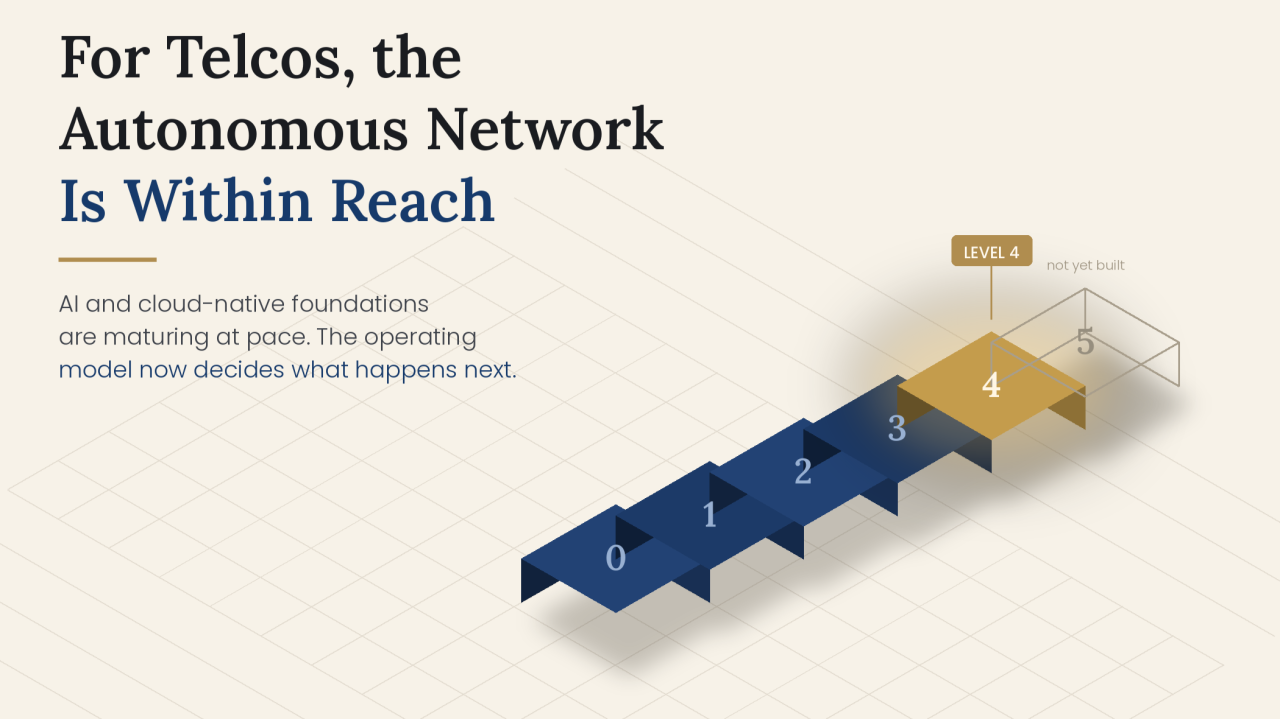
TM Forum’s Level 0 to 5 taxonomy remains the most useful frame for this discussion, largely because it keeps the debate honest. Its March 2026 benchmark, drawing on 125 respondents at 80 companies, puts 59% of respondents at Level 2 for their network overall, 21% at Level 3 and only 6% claiming Level 4. The share at Level 3 or above rose from 19% to 21% in a year. Progress is real, and it is slow.
Ambition tells a different story. TM Forum’s June 2026 research, based on a survey of 80 operators, found that 20% expect to reach Level 4 or above by 2027, rising to 81% by 2030. I do not read the distance between 6% today and 81% by 2030 as an ambition problem or a technology problem. I read it as an operating model problem, and the rest of this paper is about why.
It is also worth reading the certifications carefully, and TM Forum deserves credit for making this possible. Of roughly 50 validated assessments awarded by the end of 2025, about 30% reached Level 4. Every one of those Level 4 validations used alpha-stage questionnaires, which TM Forum has since withdrawn from the certification service on the grounds that they made a Level 4 score too easy to achieve. Operators also tend to publish the scenarios where they score well rather than the ones where they do not. None of this diminishes the achievement. It does mean that a Level 4 certificate describes a scenario, not a network.
Which leads to the most important implication of the taxonomy. Level 4 is almost never achieved across an entire network at once. Operators progress scenario by scenario, domain by domain and market by market. Telefónica is instructive here: the company reports an average autonomy level of 3.05 globally with nine Level 4 use cases across Spain, Brazil and Germany, and targets an average of 3.75 by 2028 before reaching Level 4 by 2030. That is what a serious roadmap looks like. The real shift is not from manual to autonomous. It is from isolated task automation to governed autonomy.
3. Where operators are proving value

The strongest use cases are not theoretical, and the industry has converged on a clear order of priority. Service assurance leads at 78% of respondents rating it high priority, followed by troubleshooting at 74%, then complaint handling and quality optimisation at 55% each. These are the domains where data is available, where the return is legible, and where the operational risk of getting it wrong is manageable.
The results behind them are increasingly specific. China Mobile reached Level 4 in its network operations centres through automated agents and copilots, reporting an 80% reduction in major network faults and a 30% average reduction in fault and customer complaint mean time to repair, alongside the equivalent of 5,500 manual roles redeployed by the end of 2024. Telkomsel’s east Indonesia pilot of AI-driven predictive operations improved its customer experience index by 14.7% and cut wireless traffic loss by 12.6%. MTN South Africa achieved Level 4 validation for IP network optimisation, and Rakuten Mobile did the same for RAN energy efficiency in a live Open RAN environment, delivering around 20% energy conservation. Deutsche Telekom reduced the time needed to manage a major event from hours to about a minute. In field operations, Microsoft now manages more than 65% of fibre-break field dispatches on the Azure network autonomously.
One caution on sequencing, because I see it get this wrong in planning conversations. Network planning and design sits lowest in the industry order of priority at 33%, and TM Forum’s own scenario map does not treat planning and deployment as high priority for the next two years. It is the next frontier rather than proven ground, and I would not anchor a first business case on it.
4. The execution gap

Here is the finding that reframed this topic for me. When TM Forum asked respondents which parts of anomaly resolution they had made autonomous, 66% had automated detection, 49% root cause location, 49% decision, and only 34% execution. The same shape appears in customer experience assurance: 66% detect the issue, 60% determine root cause, 40% determine the corrective action, and just 26% implement it. Network configuration change and adaptation sits at 27% against 65% for fault monitoring.
The industry has automated seeing. It has not automated doing. Every percentage point of that decline is a place where a human still has to be in the loop, and the reasons are rarely technical. They are questions of trust, of blast radius, of whether an action can be explained to a regulator afterwards.
The reported obstacles confirm it. Cross-domain integration complexity is rated very challenging by 60% of respondents, up from 53% a year earlier, followed by budget and competing capex priorities at 54%, legacy software processes unsuited to AI at 52%, and the absence of a defined end-to-end architecture or path to Level 4 at 44%. Data quality is the single largest data-specific obstacle at 61%, with siloed data at 45%. Not one of these is a model problem.
This is why I am cautious about treating AI as the transformation rather than the accelerant. AI deserves its central place in the story, and it is the main reason network automation has regained momentum. But four foundations still have to move together. Trusted and accessible data comes first, and it is where most programmes underestimate the work. Operational processes have to be redesigned for autonomy rather than mapped. People, skills and ways of working have to change, with engineers collaborating with agents in clearly defined new roles. And adoption, change management and governance have to be deliberate, with measured rollout, auditable action and retained human oversight. AI can strengthen every one of these. It can substitute for none of them.
5. Building the Network Harness

If the execution gap is the constraint, then the answer is not another use case. It is the layer beneath the use cases. I think about it as three blocks, and Microsoft’s contribution sits inside them rather than alongside them.
Network IQ is the shared intelligence layer for network operations, unifying telemetry, topology, service context, OSS and BSS data, operational knowledge and policy. In the Microsoft stack this is Fabric and OneLake, and the point that matters is that unification does not require consolidation. Data can be referenced where it already sits, replicated where that is simpler, or reached inside the operator’s own data centres through a gateway. Inventory can stay on-premises, telemetry can sit in another public cloud, and a national market can keep its customer data in country, while all of it is queried and governed as one logical estate. In telecom that is rarely a convenience and usually the only lawful option. Heavily customised inventory, mediation or activation systems will still need real integration work, and that is precisely the work I want done once and inherited by every use case that follows.
Customer IQ applies the same discipline to the customer pane. Service-to-customer mapping, experience signals, care interactions, complaint history and customer value, sitting on the same data estate rather than a parallel one. This is the block operators tend to defer, and I would argue it is the one that converts autonomy from a cost programme into a revenue programme. A fault becomes answerable not only as what broke, but as who is affected, which of them matter most commercially, and what we tell them first. That is the bridge to the argument TM Forum is now making about Level 4 as a growth strategy rather than an efficiency one.
The Network Harness is what connects the two and makes autonomy scale. It is the reusable operating fabric: the NOA reference architecture, shared agents and skills, common workflows, one governance model and one runtime. Two things sit inside it. At the engineering layer, a coding harness with skills, memory and middleware, integrating the GitHub Copilot SDK, and Microsoft treats that layer as a flex point rather than a lock-in, which keeps model and framework portability in the operator’s hands rather than the vendor’s. Around it, Microsoft Foundry supplies what a production estate needs: a skills library, MCP connections and tools, managed memory, hosted agents, runtime model routing that turns model cost from a fixed vendor price into an engineering variable, retrieval across both intelligence layers, and observability. Expanded TM Forum Open API support keeps all of this alongside existing OSS and BSS rather than in place of them, and agents publish into Teams and Microsoft 365 Copilot so that engineers work where they already are.
Governance is the part that matters most in this industry. Agent traffic inherits the identity, content safety and observability policies already set for the fleet, and it lands in the same telemetry and dashboards as everything else rather than becoming a separate integration with its own access model. The governing question stops being what an agent is capable of and becomes who ran it, under which policy, and where the trace landed. That is the question a regulator asks, and it is the one that ends most autonomy conversations when there is no good answer.
Microsoft Frontier Company is the delivery block, and its composition matters as much as its scale. It brings together three things: deep industry knowledge, change management and continuous improvement experience, and enterprise-grade AI engineering expertise. The delivery mechanic underneath is forward-deployed engineering, with engineers working inside operator teams to co-design, build, deploy and keep improving the systems rather than handing over a platform and leaving. It is the combination that matters. Forward-deployed engineering on its own produces good software that nobody adopts. Industry knowledge and change capability on their own produce good advice that nobody builds. Together, and held to measurable outcomes rather than milestones, they are what Microsoft means by outcome-driven engineering, backed by a 2.5 billion dollar investment and more than 6,000 professionals drawn largely from existing forward-deployed teams.
That combination matters for the argument in this paper, because the harness does not build itself. Somebody has to sit inside the network operations centre, understand why a particular alarm correlation rule exists, turn it into a reusable agent rather than a bespoke script, and then persuade the shift supervisor to trust it. The first is engineering, the second is industry knowledge, the third is change management. Take any one away and the harness stays a prototype.
One practical point, because it comes up in every conversation I have on this. Most operators already run their transformation through system integrators and advisory partners, and embedded Microsoft engineering does not displace those relationships. Microsoft has extended the forward-deployed model into those organisations, so an operator’s existing partners can work inside the same engineering approach rather than alongside a parallel one. For an operator with a decade of accumulated context sitting inside a partner relationship, that continuity is worth more than any individual capability in the stack.
I would also rather point to what we run ourselves than to what we sell. Microsoft operates the Azure global network this way, and the results are public: more than 65% of fibre-break field dispatches managed autonomously, a 60% reduction in time to detect fibre issues, a 25% improvement in time to repair, root-cause analysis 80% faster, and a flat staffing curve as incident volume rose. During a subsea cable cut, agents activated overnight, evaluated alternative routing and contacted partners without a human initiating any of it. Far EasTone has embedded agentic AI across its network operations centre and change management workflows using the NOA framework, with roughly 60% of its NOC operations now AI-assisted, and Vodafone is applying the same blueprint across transport infrastructure and field-force management.
The route through is deliberately staged. Assess the baseline by domain, process and market. Define the target state with interim goals, because 3.75 before 4 is a more honest destination than a round number. Prioritise a portfolio of use cases on value, data readiness and risk. Build the harness that connects Network IQ, Customer IQ and shared workflows. Measure continuously across both business outcomes and autonomy maturity. And tie every project back to the overall Level 0 to 5 ambition, so that individual wins accumulate into something an executive committee can recognise.
What should operators track? When TM Forum asked which improvement indicators matter most, rather than what respondents had achieved, the answers clustered tightly: 82% named reduced operations and maintenance cost, 81% fault prediction accuracy, 80% fault handling duration and 78% fault handling automation rate. That consensus is useful, because it means a business case built on those measures will be legible to peers and to an executive committee. To them I would add three that are less commonly instrumented and more diagnostic: the rate of human intervention, rollback and confidence metrics, and above all the degree of use-case reuse. Reuse is what separates an interesting pilot from an industrialised transformation, and it is the one metric that tells you whether you are building a harness or another island.
6. Conclusion
The telecom industry has pursued automation for decades, but the conditions are genuinely different now. Stronger digital foundations, compounding demand, rising complexity and constrained economics are converging, and AI has arrived with enough capability to matter. That combination makes autonomy a practical necessity rather than a distant aspiration.
The route forward is also clearer than the maturity numbers suggest. Operators do not need to wait for a fully autonomous network. They can move scenario by scenario, building maturity over time, while using AI to accelerate diagnosis, planning and execution. The operators who pull ahead will not be the ones automating fastest. They will be the ones automating once, in a way that the next domain and the next market can inherit.
So I am more optimistic than the maturity numbers on their own would suggest. The autonomous network is within reach, and I do not think that has been true before. But reach is not the same as arrival, and Level 4 is not a milestone waiting to be purchased. No platform arrives with it included. It is the cumulative result of many use cases progressing at different speeds under a common maturity framework, a shared harness layer and a disciplined operating model. Build that, and Level 4 stops being plausible and starts being executable.
References
1. GSA, State of the Market report, April 2026 (5G Standalone launches to end March 2026). https://gsacom.com/paper/state-of-the-market-april-2026/
2. GSMA, From Ambition to Execution: How Open Gateway Is Scaling the Global API Economy, March 2026. https://www.gsma.com/newsroom/article/from-ambition-to-execution-how-open-gateway-is-scaling-the-global-api-economy/
3. Ericsson Mobility Report, mobile network traffic Q1 2026, June 2026. https://www.ericsson.com/en/reports-and-papers/mobility-report/dataforecasts/mobile-traffic-update
4. Ericsson Mobility Report, mobile data traffic forecast to 2031, June 2026. https://www.ericsson.com/en/reports-and-papers/mobility-report/dataforecasts/mobile-traffic-forecast
5. PwC, Perspectives from the Global Telecom Outlook 2025-2029. https://www.pwc.com/gx/en/industries/tmt/telecom-outlook-perspectives.html
6. Dell’Oro Group, Worldwide Telecom Capex to Decline in 2026, April 2026. https://www.delloro.com/news/worldwide-telecom-capex-to-decline-in-2026/
7. TM Forum, Assessing CSPs’ progress towards Level 4 autonomous networks, Benchmark Report, March 2026. https://inform.tmforum.org/
8. TM Forum, 2025 Autonomous Operations Maturity (AOMM) Industry Insights, IG1346 v2.0.0, January 2026. https://www.tmforum.org/
9. TM Forum, Autonomous Networks Leadership Forum and the Scaling to AN Level 4 report, June 2026. https://www.tmforum.org/news-insight/newsroom/autonomous-networks-leadership-forum-spotlights-level-4-shift
10. TM Forum, China Mobile achieves Level 4 AN in network operation centres with intelligent agents. https://inform.tmforum.org/research-and-analysis/case-studies/china-mobile-achieves-level-4-an-in-network-operation-centres-with-intelligent-agents
11. Deutsche Telekom, MINDR multi-agent network diagnostics and remediation. https://www.telekom.com/en/media/media-information/archive/mindr-ai-agents-in-the-network-1102724
12. Microsoft, Evolving the Network Operations Agent Framework, February 2026. https://techcommunity.microsoft.com/blog/telecommunications-industry-blog/evolving-the-network-operations-agent-framework-driving-the-next-wave-of-autonom/4496607
13. Microsoft, Introducing Microsoft’s Network Operations Agent, a telco framework for autonomous networks. https://techcommunity.microsoft.com/blog/telecommunications-industry-blog/introducing-microsoft%E2%80%99s-network-operations-agent-%E2%80%93-a-telco-framework-for-autonom/4471185
14. Microsoft, From Copilots to Coworkers: How AI Agents Are Transforming Azure Networking Operations, May 2026. https://techcommunity.microsoft.com/blog/appsonazureblog/from-copilots-to-coworkers-how-ai-agents-are-transforming-azure-networking-opera/4519850
15. Microsoft, MWC 2026: Microsoft accelerates telecom return on intelligence with a unified, trusted AI platform. https://www.microsoft.com/en-us/microsoft-cloud/blog/telecommunications/2026/02/24/microsoft-accelerates-telecom-return-on-intelligence-with-a-unified-trusted-ai-platform/
16. Microsoft, Microsoft Frontier Company: AI engineering that amplifies and protects your intelligence, July 2026. https://blogs.microsoft.com/blog/2026/07/02/microsoft-frontier-company-ai-engineering-that-amplifies-and-protects-your-intelligence/
17. Fierce Network, Microsoft telco CTO details where AI is paying off and where it has not, March 2026. https://www.fierce-network.com/cloud/microsoft-telco-cto-details-where-ai-paying-and-where-it-hasnt
This article was first published on LinkedIn on August 9, 2026.
Leave a Reply